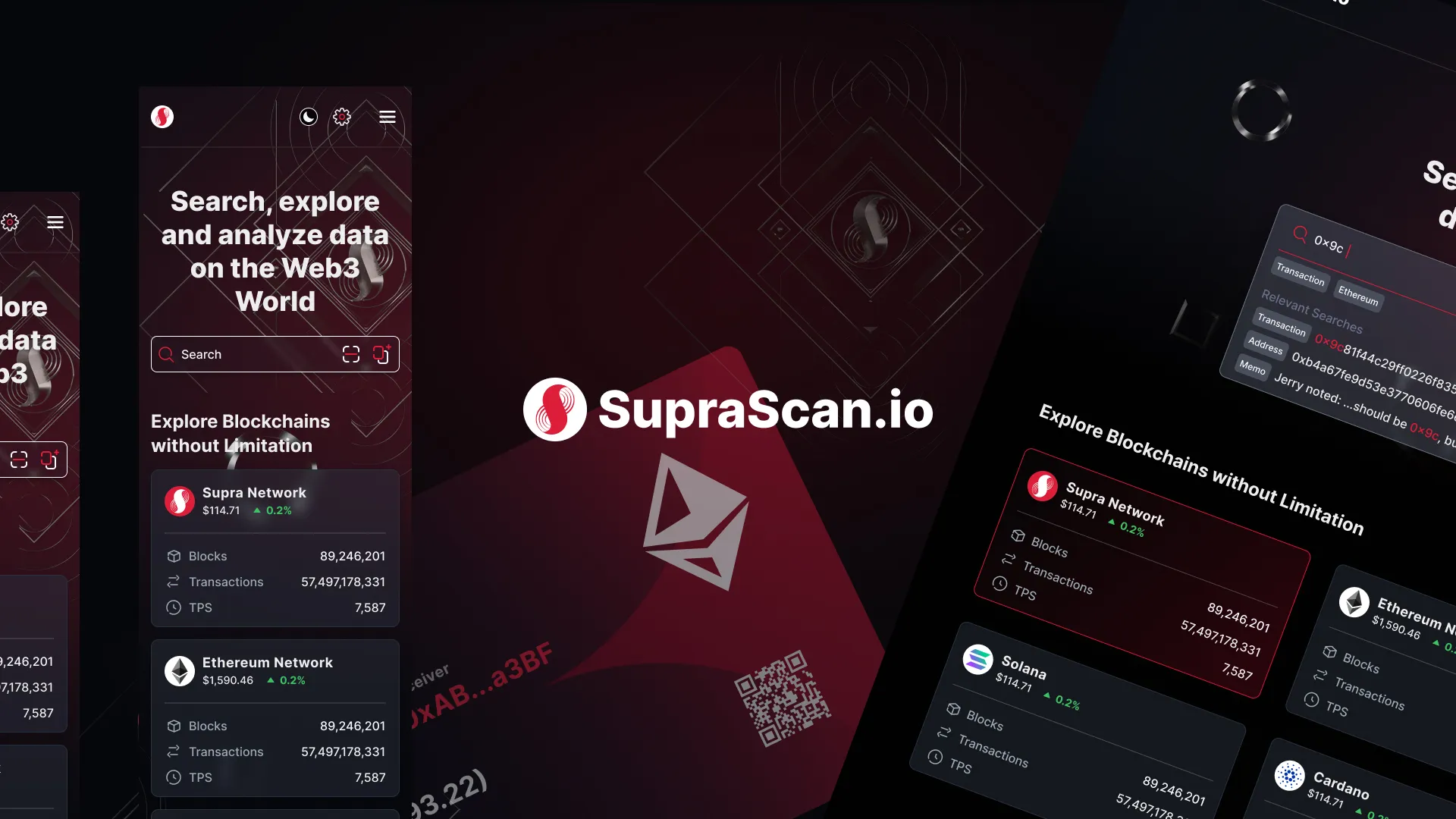
Supra Block Explorer — Making Blockchain Data Accessible
Managing the end-to-end design of a comprehensive blockchain explorer covering search, transactions, cross-chain tracking, addresses, and NFTs for the Supra network.
What needed solving
Supra needed a world-class block explorer that could surface complex blockchain data — transactions, cross-chain transfers, contract addresses, and NFTs — in a way that both developers and everyday users could navigate with confidence. Existing explorers were fragmented, data-dense, and hostile to non-technical users. The project required coordinating design across 6 major feature areas while maintaining a unified experience and a scalable component system.
Rules I worked within
Must handle 6 distinct data domains (search, transactions, cross-chain, addresses, NFTs, blocks) within a single cohesive interface.
Cross-chain transaction tracking required visualizing multi-step asset flows across networks with real-time status updates.
Design system had to scale across 100+ unique screens while maintaining visual and interaction consistency.
Must serve both technical blockchain developers and non-technical users exploring the network for the first time.
Measurable outcomes
Managed the delivery of 100+ high-fidelity screens across search, transactions, cross-chain flows, address details, NFT results, and homepage iterations.
Coordinated design for Search Engine, Search Results, Transactions, Cross-chain Transactions, Address pages, and NFT discovery.
Delivered a complete component library — icons, buttons, navigation, lists, cards, elements, and modules — with color palette, typography, and interaction guidelines.
Led the project from initial wireframes through iterative design rounds to polished high-fidelity deliverables ready for engineering handoff.
“A block explorer is only as good as its information architecture — organizing complexity into predictable patterns is what makes raw blockchain data feel navigable.”
This design has since been changed by Supra.